Enhancing Customer Retention
Text Messaging Feature
Project Details
ROLELead Product Designer
TYPE OF DESIGNCommunication & SMS
RESPONSIBILITIESCustomer interviews
Competitive analysis
Wireframe & final design
Usability testing
Component design & development
PRODUCTJobber, 2020
Background & Context

OVERVIEWAt Jobber–a SaaS platform built for small home service businesses–we noticed a recurring trend: customers were downgrading from the premium Grow plan to the more basic Connect plan. This raised a key retention challenge. In response, our team identified an opportunity to increase the perceived value of the Grow plan by investing in high-impact features–leading to the proposal and development of Jobber’s first messaging feature.
PROBLEMHistorically, Jobber only supported outbound, templated SMS notifications–such as quotes, job updates, and invoice reminders–with no way for clients to respond back. This presented challenges for our customers in a saturated, home services industry where the key differentiators for a successful business and recurring leads equated to quick communication, customer service and speed of work.
SOLUTIONOur new two-way messaging feature aimed to enable richer, more flexible communication. Customers would be able to register a business phone number through Jobber and exchange real-time messages with their clients–streamlining communication and improving service responsiveness. This feature also aligned with emerging communication preferences of millennial homeowners who favoured text-based messaging.

Design Problem & Strategic Focus
Our design challenge was twofold – we needed to understand the communication pain points of our fieldworkers and build a feature that was intuitive, minimally disruptive, and time-saving. The guiding question for myUX approach was:
How might we design a two-way messaging tool that aligns with existing workflows and enhances Jobber’s ecosystem without adding friction?
By anchoring the work in user research and context-driven design, my team ensured that our solution not only improved responsiveness for time-sensitive requests (like quote approvals or urgent job updates), but also reinforced trust between service providers and their clients–leading to better customer satisfaction and stronger business relationships.
Process
Gathering Qualitative Data
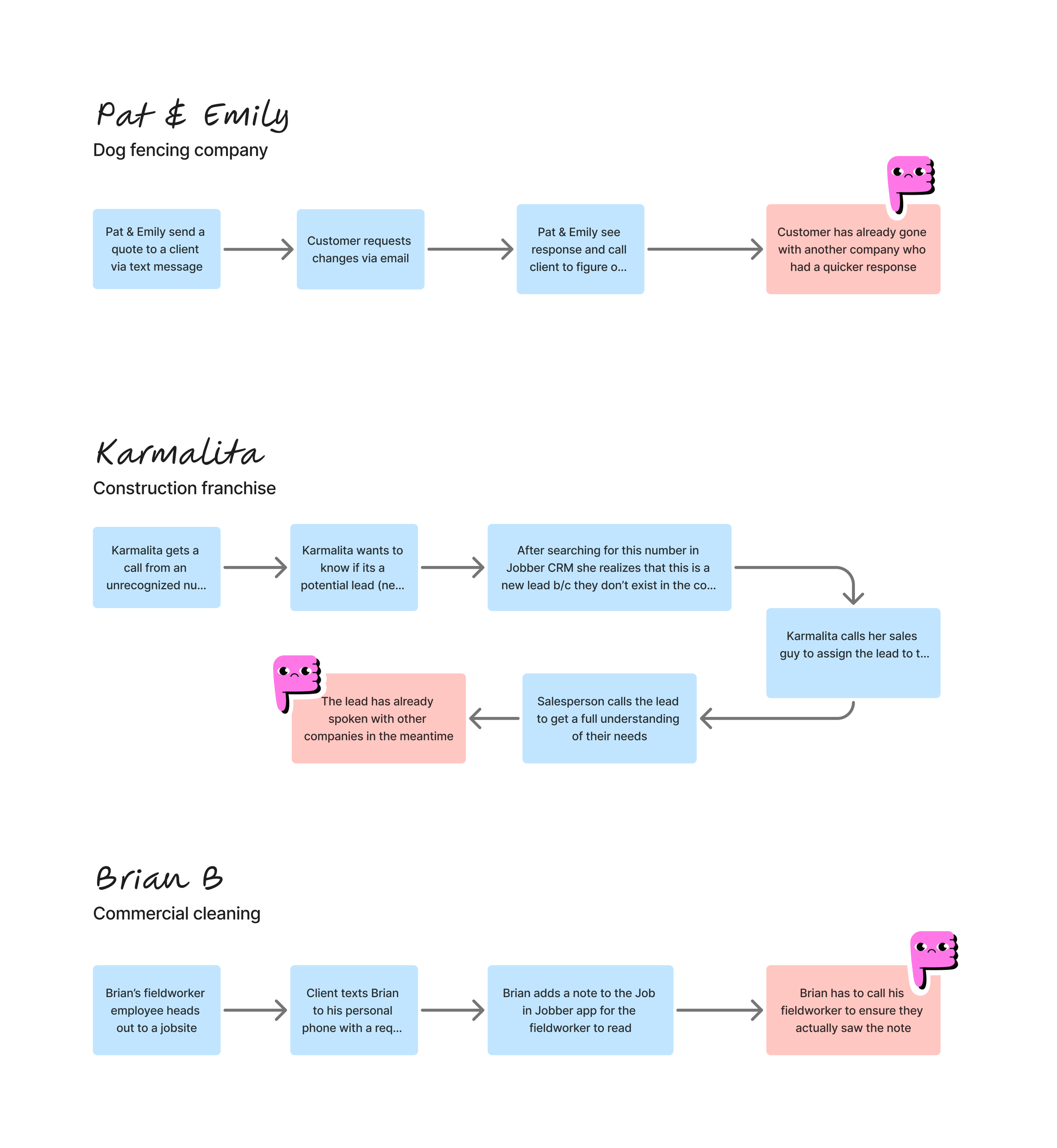
To ground the design in real customer needs, I started by reviewing existing Voice of Customer feedback channels (such as our customer success slack group, the Jobber Entrepreneurship Facebook group and our #voice-of-customer slack channels). This gave me an initial sense of how customers expected to use a text messaging within Jobber. It also gave me a better understanding of third-party tools they were turning to in order to communicate with their clients.
Partnering closely with my product manager and tech lead, I conducted some discovery customer interviews to explore these identified patterns in more depth. We focused on uncovering how and why they used third-party messaging apps, their expectations for a native Jobber solution, and the challenges they faced in their businesses without integrated communication. These conversations revealed how the absence of built-in messaging slowed their ability to respond to clients, creating friction in otherwise time-sensitive interactions.
DEFINESynthesizing Insights
Following the interviews, we distilled our findings into two clear areas: the challenges customers faced with Jobber’s existing text communication, and their motivations for adopting a true two-way messaging tool.
Challenges
❌ Customers felt they were constrained to canned, template-based messages with no room for customization
❌ Customers had no ability to receive or manage client replies
❌ Outgoing messages from Jobber were frequently flagged as spam
❌ There was no centralized record of conversations for future reference
Motivations
✔ Customers wanted to deliver a more personalized, human customer interactions
✔ Responding to clients quickly and efficiently was extremely important to lead referrals
✔ Maintaining a professional image would help them stay on par with larger competitors
✔ Building trust and long-term client relationships was extremely important to the growth of their business
✔ Improving communication would driving faster, more positive business outcomes
Competitive Research
To complement our customer insights, I conducted an in-depth review of the third-party messaging tools customers relied on, as well as how competitors approached native text messaging. I documented patterns in features and workflows that could inform our MVP discussions, highlighting opportunities to balance immediate customer needs with Jobber’s long-term product vision.
IDEATEFinal Design
In both Jobber desktop and the app, the feature was designed for seamless accessibility and speed by always being accessible from side panel component–allowing users to engage from anywhere in the product. The feature was accessed through a message icon in the top, global navigation bar–ensuring users could easily see notifications for new messages and respond quickly. This placement prioritized speed and productivity.
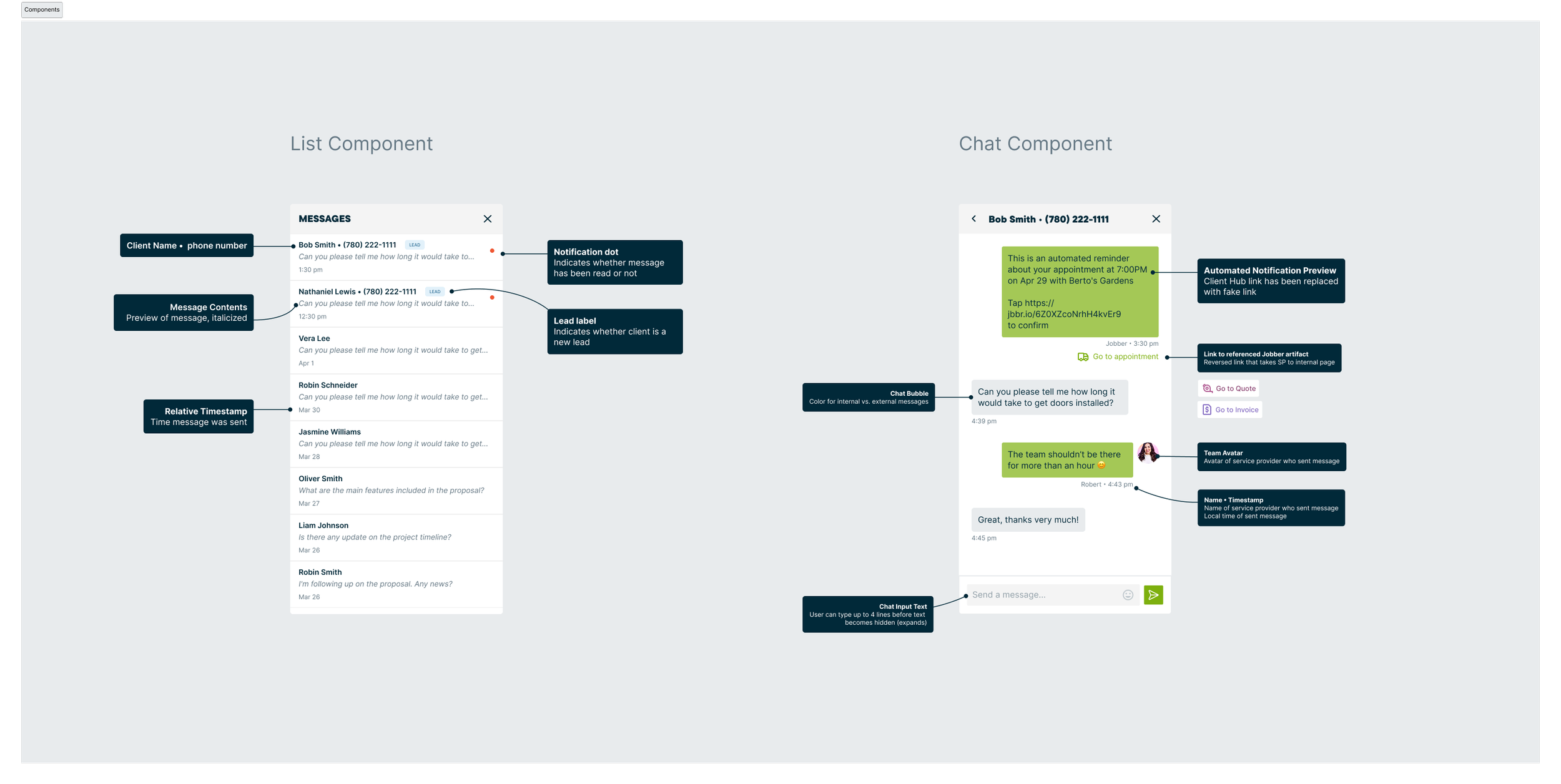
Clicking the icon opened a drawer-style messaging panel with a subtle overlay, ensuring users could reference key job details while keeping conversations in view. Working with engineering team , I developed several new design system components to deliver a consumer-grade experience. This included a chat bubble, relative time stamp, and further enhancements to an existing list component. The components were designed to be reusable, enabling other teams to easily incorporate them into their own projects.
This project marked Jobber’s first end-to-end implementation in React–setting the stage for broader adoption of this modern tech stack within the company. One of the most impactful differentiators–which was informed directly by customer feedback–was the ability to link related objects (quotes, jobs, invoices, requests) directly within the thread. This gave service providers instant access to the right documents, helping them resolve client questions faster, close more business, and get paid sooner.
Upgrade Path Design
Building on the success of the quote follow-up upgrade path, we applied a similar strategy here in order to drive adoption of the new messaging feature. Our goal was to highlight the feature’s value for lower-tier customers and encourage upgrades from the Connect Plan to the Grow plan. We designed a modal-to-landing-page flow triggered by a subtle “new” label on the message icon. When clicked, the modal introduced the benefits of two-way messaging–personalized communication, faster response times, and improved professionalism–before guiding customers to a dedicated landing page for deeper exploration and upgrade prompts.
This approach balanced discoverability and education, ensuring that customers understood the value of the feature at the moment of engagement, while giving them a clear path to act.
Go-to-Market & Media Coverage
This was a major milestone for Jobber, and our marketing team worked strategically to amplify its reach to both customers and the broader public. The launch of two-way messaging attracted significant attention and was featured in Jobber Academy, Business Wire, and HVACR Business.
These features not only showcased the new capability but also positioned Jobber as an innovator in client communications, reinforcing the company’s leadership in the home service SaaS market and demonstrating how thoughtful product design could deliver tangible impact for both customers and the industry.
Impact
Two-way text messaging was an immediate success within Jobber. Customers on the Grow plan were thrilled to finally have a communication record for each client–a single source of truth their teams could rely on to manage interactions. Their clients, in turn, appreciated being able to respond to automated notifications, which improved responsiveness and strengthened trust. This feature deepened customer–client relationships and created tangible business value.
Most notably, the project played a crucial role in securing Series C funding. Two-way messaging quickly became one of the top reasons customers upgraded to the Grow plan, driving steady adoption and influencing Jobber’s long-term product strategy. Soon after launch, the company invested in two dedicated teams to expand the communication hub, including the addition of Voice, a call centre solution.
On a personal level, this project marked my first experience working with React—while Jobber was still primarily built on Ruby on Rails (an older tech stack). Reconciling new and legacy stacks required close collaboration with engineers, reworking designs to fit technical constraints, and making hard scope decisions (such as cutting search functionality for the first iteration) to hit deadlines. It was a valuable learning experience that strengthened my ability to design quick, effective solutions within real-world limitations, while still advocating for the best possible user experience.