Product-led Growth
Customer Journey Mapping
Project Details
ROLELead Product Designer
TYPE OF DESIGNUpgrade path design, marketing
RESPONSIBILITIESCustomer journey mapping
Customer research and interviews
Competitive analysis
Wireframing & final design
Company-wide presentations and knowledge sharing
PRODUCTJobber, 2019
Background & Context
OVERVIEWJobber is a business management platform built for home service companies. This project focused on driving in-product upgrades by improving the visibility of features available to them outside their current plan.
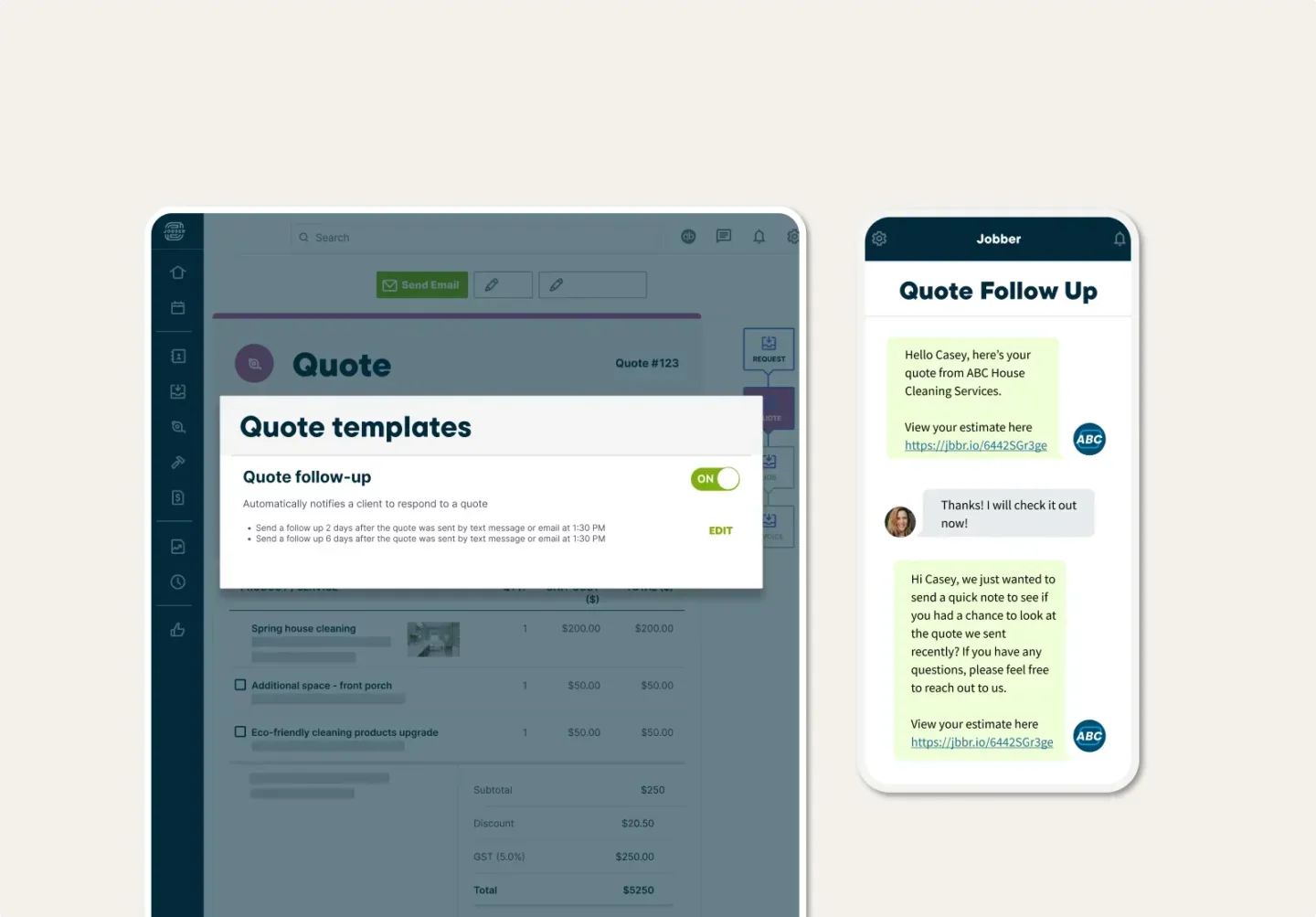
PROBLEMAt the time, most upgrades to the highest plan tier (Grow) only happened after customers spoke with the Customer Success or Sales teams and learned about features that may help their growing business. Our team wanted to reduce this dependency and drive scalable growth by highlighting upgrade-worthy features directly inside the product. One of the most valuable at the time was Quote Follow-Ups. This automated reminder system reduced lost revenue from unapproved or unpaid quotes yet awareness of this feature among customers remained low.
SOLUTIONI led UX discovery and design, collaborating closely with product and engineering to understand how to make this feature more visible, desirable, and upgrade-driven. Through user interviews, feature usage analysis, and competitor audits, I identified UX patterns to drive in-product education and upgrade intent–laying the foundation for future conversion experiments.
PROCESSCustomer Journey Mapping
To uncover how we could better surface and position Quote Follow-Ups, I led a customer journey mapping exercise in collaboration with our growth designer. We developed a comprehensive customer journey map that traced the full upgrade path–from initial awareness of Quote Follow-Ups through to activation after purchase. To inform this map, I conducted stakeholder interviews across customer success, sales, and marketing, uncovering friction points and opportunities at each stage of the funnel. The customer journey map below illustrates the existing process for purchasing Quote Follow-Ups. It was created through interviews with stakeholders and via customer insights gathered.
Our goal was to understand how lower-tier customers encountered, evaluated, and ultimately upgraded to the Grow plan.
DEFINEThree critical insights emerged that shaped our design strategy:
Lack of Awareness:
Most Connect users were unaware of the Quote Follow-Ups feature unless they reached out to the Success team. Over 60% of our upgrade revenue was driven by these 1:1 conversations, revealing a major gap in in-product discoverability.
Misaligned Value Perception
While Quote Follow-Ups offered clear utility, the overall Grow plan felt expensive to many customers. Users didn’t see enough value in the broader feature set, making upgrades harder to justify based on cost alone.
Human Influence was Important
Customers who engaged with a Sales representative were more likely to upgrade. Reps were able to articulate the return on investment, often using specific financial impact scenarios (e.g., missed revenue from unconverted quotes).
IDEATEUsing these insights, I partnered with my Product Manager and Lead Engineer to identify and prioritize some key design improvements which could increase upgrade conversions to quote follow-ups. We focused on the following opportunities:
Enhance Feature Discoverability
I proposed contextual in-app messaging triggered when users accumulated multiple unanswered quotes (a painpoint which the CS and Sales teams mentioned would trigger upgrades over the phone). This would highlight Quote Follow-Ups at the most relevant moment of need.
Clarify Plan Value
We explored educational upgrade surfaces that clearly explained the ROI of the Grow plan—not just for Quote Follow-Ups, but for other tools that streamline operations and drive revenue.
Improve Upgrade Onboarding
While onboarding prompts were part of our initial plan, technical constraints required us to simplify and refocus onboarding flows for clarity and immediacy. Our revised approach emphasized ease of activation and immediate feature impact.
Stakeholder Buy-in
With these opportunities in mind, I developed a new customer journey map that integrated each of these strategies into a cohesive plan for enhancing the discoverability of Quote Follow-Ups. This ideal journey map was essential for communicating the potential benefits of our approach to stakeholders.
DESIGNPOST-RELEASEHow can we effectively communicate the value of Quote Follow-Ups and the Grow plan at the moment of upgrade?
While the upgrade path successfully encouraged Connect customers to move to the Grow plan, our journey mapping uncovered a critical insight: retention depended on early success. Customers who connected with a product coach shortly after upgrading were far more likely to adopt new features and less likely to downgrade.
To address this, I designed in-product onboarding prompts that encouraged newly upgraded customers to book a session with a product coach. This ensured they received guided support on Quote Follow-Ups and other Grow features at the exact moment they needed it most.
By extending the upgrade experience into post-purchase onboarding, we not only celebrated the win of upgrading but also helped customers realize ongoing value–turning a conversion into a long-term success story.
How might we improve the discoverability of Quote Follow-Ups within the Connect plan experience?
Based on our research insights, I designed a targeted upgrade experience to help Connect customers see the value of Quote Follow-Ups and encourage plan upgrades to Grow. The solution was built around three core elements:
An Upgrade Path
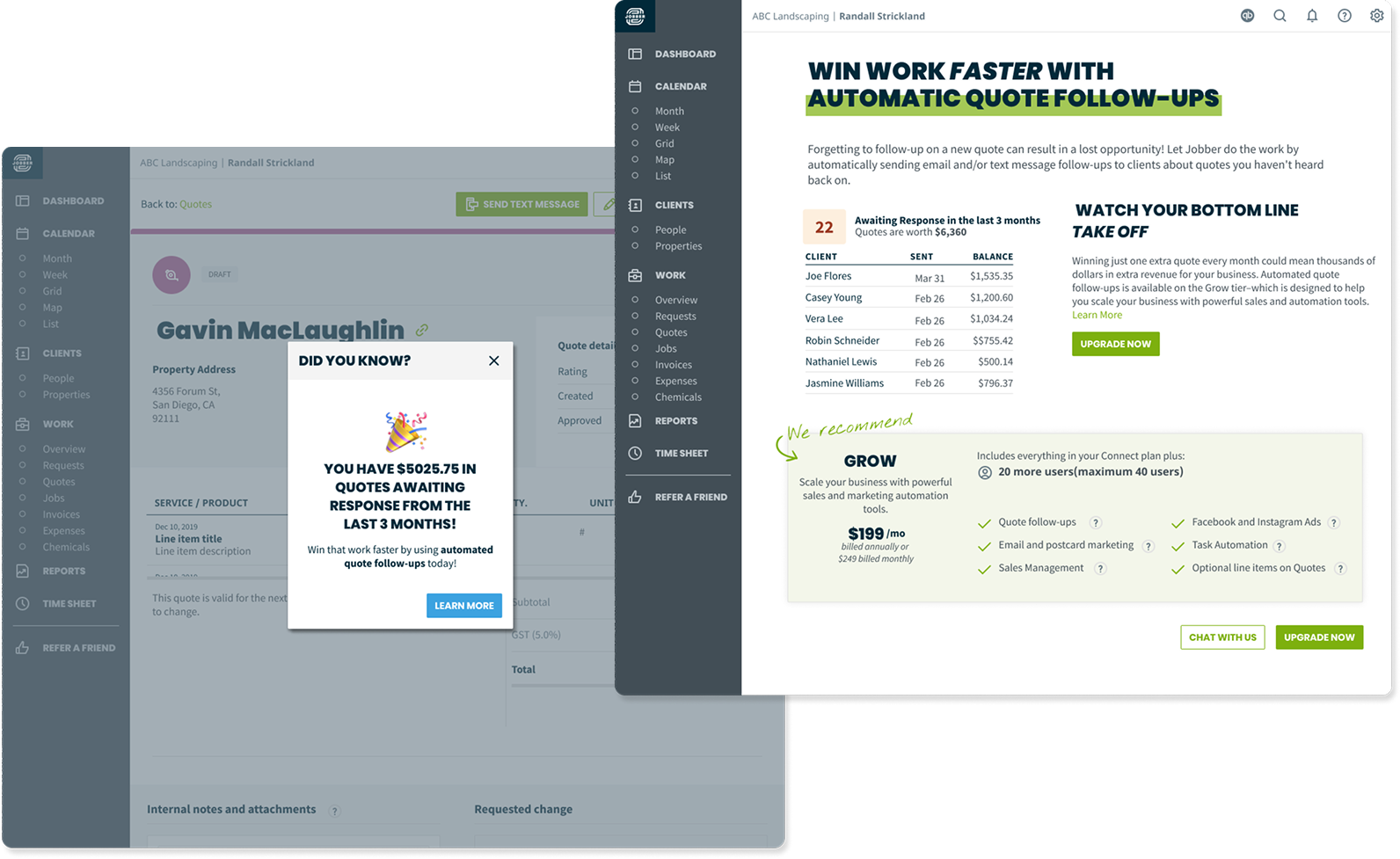
A smart prompt was triggered when users had more than six quotes in an “awaiting response” state. The modal highlighted the potential profit loss by calculating the total dollar value of outstanding quotes from the past three months–making the value of upgrading tangible and time-sensitive.
A Dedicated Landing Page
From the modal, users were guided to a landing page that showcased the full benefits of the Grow plan. The page featured clear calls-to-action, a chat module to connect with a sales representative, and a celebratory confetti animation post-upgrade–transforming a transactional moment into one of achievement and delight.
Tracking and Optimization
We implemented analytics across the flow to measure engagement and identify drop-off points. This data-driven approach allowed us to continuously refine the experience and improve upgrade conversion rates over time.
Final Outcomes
The strategy derived from our customer journey maps proved highly successful for both Jobber and our customers. Within a few months of running the experiment, we observed an 18% upgrade rate to the Grow plan among users who saw the modal prompt and visited the landing page. This not only helped customers realize the value of Quote Follow-Ups for their businesses but also drove a measurable increase in monthly recurring revenue (MRR) for Jobber.
Within a few months of running the experiment, we observed an 18% upgrade rate to the Grow plan among users who saw the modal prompt and visited the landing page.
The success of this upgrade path and landing page inspired other teams to adopt similar approaches for promoting underused features across the product. To share learnings, I presented my process to the product design team, which helped spark a design-led initiative focused on mapping customer journeys more broadly across Jobber.
This project underscored the value of understanding the end-to-end customer journey before jumping into prototyping. It reinforced the importance of engaging with cross-functional stakeholders to build a holistic view of the customer experience—much of which happens outside the product itself. Since then, I’ve consistently leveraged journey mapping to uncover pain points, moments of truth, and opportunities, refining my approach to designing user experiences that drive both customer success and business growth.